Analysis of the reasons why the thawing machine cannot be started
1. Whether the refrigeration compressor starts normally
1. Is the transmission belt broken or loose? If the transmission belt is too loose, it will slip, accelerate wear and fail to transmit power.
2. Is there any noise inside the compressor?
Possible reasons: The noise may be caused by damaged internal parts. Internal wear prevents effective compression.
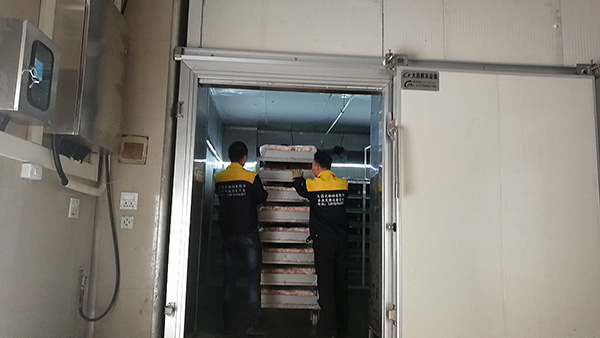
2. Reasons for condenser and fan
1. Whether the condenser heat sink is covered with dust
Possible reasons: If the condenser fins are covered with dust, the efficiency of the condenser will be greatly reduced.
2. Check whether the condenser fan is operating normally.
3. Condenser fan operation
Note: Run the fan at three speeds: "low, medium and high". If there is any abnormal noise or the motor is not running properly, it should be repaired or replaced, otherwise the air supply airflow will be insufficient.
4. Inspection of refrigerant liquid volume
1. If you see a large number of bubbles through the observation window, it means there is insufficient refrigerant. If you pour water on the condenser to cool it down and there is still no foam visible in the observation window, it means there is excess refrigerant.
2. Check the connections and seams of each device for oil stains
Possible reasons: There is oil stains at the connections or seams, indicating that there is refrigerant leakage there, and the relevant parts should be re-strengthened or replaced. (A leak detector can be used to detect leaks)
5. Whether the HVAC valve or thermal control windshield is closed, and whether other windshields are adjusted normally
(Note: If the compression clutch cannot be engaged, the blower fan cannot operate, the condenser fan cannot operate, etc., you should first enter the relevant electrical system to check, such as relays, sensors, circuit open or short circuit, control unit, etc.).
6. Instrument detection method
This method uses a set of refrigerant pressure gauges to find the fault location. First, close the high-pressure end and low-pressure end switches of the pressure gauge. In the shutdown state, connect the refrigerant filling hose to the corresponding maintenance valve of the compressor, and use the refrigerant pressure in the refrigeration device to discharge the air in the hose. At this time, the high and low pressure end readings should be in a balanced state (about 6kg/cm2). Start the engine and maintain it at 150rpm. The blower speed is set to the highest gear, and the air conditioner is set to the maximum position, which is in the "recirculation" state. The normal reading is:
7. Low-voltage end High-voltage end
R-134a 1.5-2.5kg/cm2 14-16kg/cm2
R-12 1.5-2.0kg/cm2 13-15kg/cm2
1. The indicated values of the pressure gauges on the high-pressure side and low-pressure side are lower than the standard values, and bubbles can be seen through the observation holes.
Reason: Air leakage in the refrigeration cycle; refrigerant is not replenished regularly.
Treatment: Use a leak detector to detect the leak, repair it, and replenish the refrigerant.
2. The low-pressure side pressure gauge indicates negative pressure, and the high-pressure side indication is lower than normal. There is a temperature difference in the pipelines before and after the liquid storage tank/dryer. In severe cases, there is frost in the pipelines behind the liquid storage tank/dryer.
Reason: The expansion valve or low-pressure pipeline is blocked, the liquid storage tank/dryer or high-pressure pipeline is blocked; the pressure bubble of the expansion valve is leaking, and the needle valve is completely closed.
Regarding the analysis of the reasons why the defrost machine cannot be started, we will briefly introduce it here. The content is for reference only. The right of interpretation belongs to Ganzhou Dachang Air Conditioning Equipment Engineering Co., Ltd. If you have any questions please contact us!
Original link: https://www.xshiyu.com/cjwt/292.html
Note: The copyright belongs to Ganzhou Dachang Air Conditioning Equipment Engineering Co., Ltd. For commercial reprinting, please contact the author for authorization. For non-commercial reprinting, please indicate the source.
Related recommendations
FAQ

Add WeChat
Main products: vacuum pre-cooling equipment, archive insecticidal disinfection and sterilization equipment, vacuum freeze dryer, thawing equipment, cultural relics archive map restoration equipment, low oxygen adjusted insecticide and disinfection machine, vacuum odor removal machine, dust removal, disinfection and purification equipment, ultra-high pressure sterilization equipment, hypoxic warehouse animal comfort and stun equipment
Copyright © 2026 Xinshiyu Equipment All rights reserved. Gan ICP No. 14002809-1 XML
 Winning Public No. 36070202000515