
How Long Does Freeze Drying Take? Factors That Affect Freeze Drying Time
How Long Does Freeze Drying Take? Factors That Affect Freeze Drying Time
Freeze drying is widely used for fruits and vegetables, pet food, meat, seafood, coffee, pharmaceuticals, and other temperature-sensitive products. One of the most common questions from businesses considering freeze drying is: How long does freeze drying take?
In general, a complete freeze drying cycle can take several hours to more than 24 hours, depending on the product and equipment. For industrial applications, the actual drying time is determined by factors such as product type, moisture content, product thickness, loading capacity, freezing temperature, vacuum conditions, shelf temperature, and the required final moisture content.
Understanding these factors is important when selecting an 工業冷凍乾燥機, because a suitable machine should match both the product characteristics and the required production capacity.
How Long Does Freeze Drying Usually Take?
There is no single drying time that applies to every product.
Some products with relatively low moisture content and thin loading layers may require a shorter cycle, while products with high moisture content or greater thickness can require significantly longer processing times.
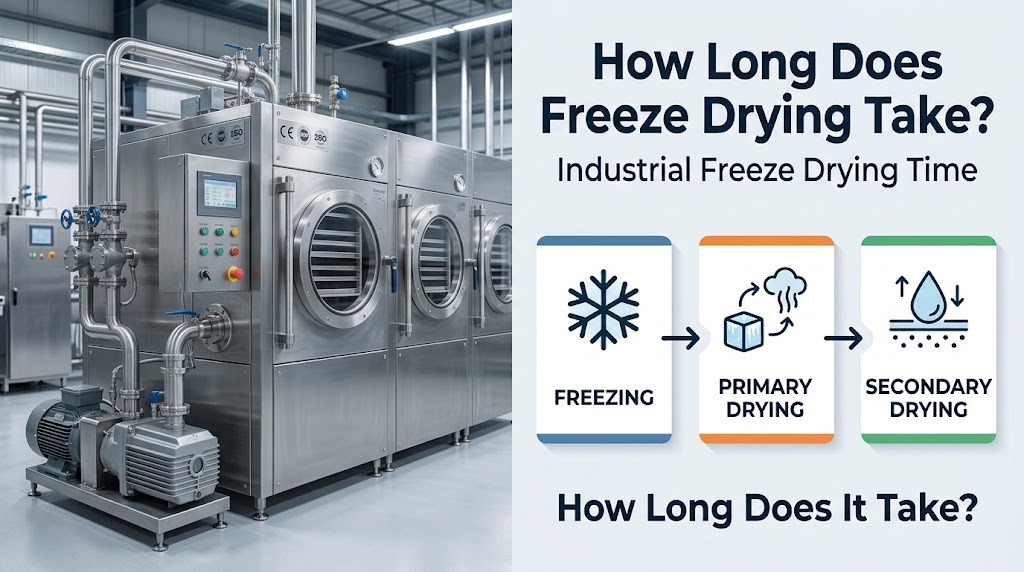
A typical freeze drying cycle consists of three main stages:
Freezing
Primary drying
Secondary drying
The primary drying stage, also called sublimation drying, usually accounts for a large part of the total processing time because most of the product's frozen water must be removed under vacuum.
For commercial and industrial production, the complete cycle may range from approximately 10 to 30 hours or longer, depending on the specific process. Actual cycle times should be established through product testing rather than relying on a fixed number.
The 3 Main Stages of the Freeze Drying Process
1. Freezing
Before drying begins, the product must be frozen to a suitable temperature.
During this stage, water inside the product changes from liquid to solid ice. Proper freezing is important because the structure of the ice crystals can influence the subsequent sublimation process.
The required freezing time depends on:
Product type
Product size
Product thickness
Initial temperature
Freezing temperature
Loading quantity
For industrial production, a properly designed refrigeration system helps achieve stable and uniform product freezing.
2. Primary Drying
Primary drying is the main sublimation stage.
After the product is frozen, the freeze dryer reduces the chamber pressure and supplies controlled heat through the shelves. Under suitable vacuum and temperature conditions, the ice changes directly from solid to vapor without passing through the liquid state.
This stage removes most of the frozen water and often represents the largest portion of the freeze drying time.
The primary drying time is strongly affected by:
Product thickness
Ice structure
Product moisture content
Shelf temperature
Vacuum pressure
Heat transfer
Condenser capacity
If the product is too thick or the process conditions are not properly controlled, primary drying can take considerably longer.
3. Secondary Drying
Secondary drying removes residual moisture that remains after most of the ice has been sublimated.
During this stage, the shelf temperature is generally increased under controlled vacuum conditions to help remove bound moisture from the product.
The required secondary drying time depends on the desired final moisture content and the characteristics of the product.
For pharmaceutical products and other applications with strict moisture requirements, secondary drying can be particularly important.
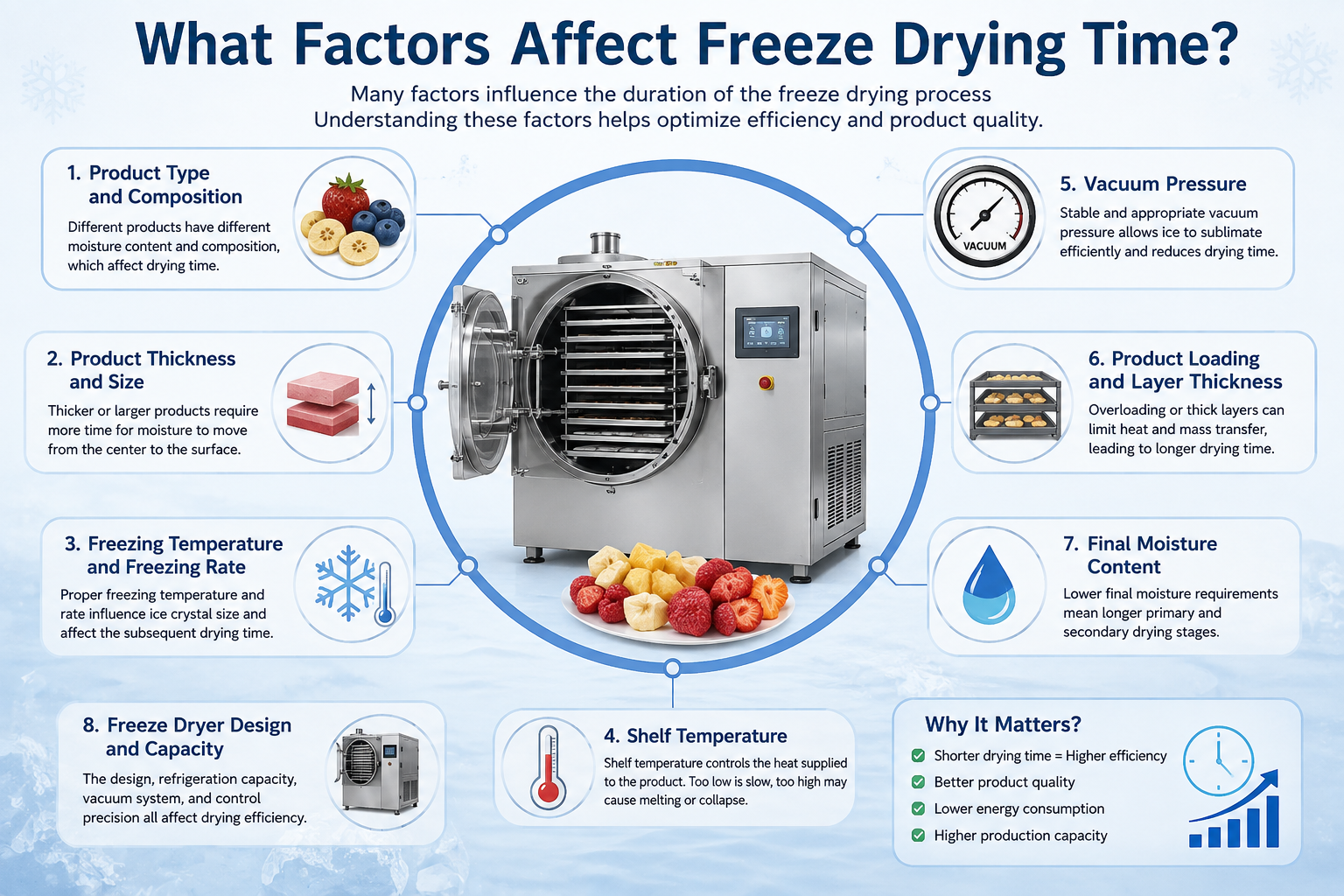
What Factors Affect Freeze Drying Time?
1. Product Type
Different products have different structures, moisture contents, and freezing characteristics.
For example, fruits and vegetables generally contain a high percentage of water, while some processed ingredients may contain less moisture.
Pet food, meat, seafood, coffee, and pharmaceutical products also behave differently during freeze drying.
Therefore, freeze drying time should always be evaluated based on the actual product.
2. Initial Moisture Content
Products with higher initial moisture content generally require more water to be removed.
For example, a product containing a large amount of free water may require a longer primary drying stage than a product with lower moisture content.
Initial moisture content is therefore an important factor when estimating the total cycle time.
3. Product Thickness
Product thickness can have a major effect on drying time.
When the product layer is thicker, water vapor has a longer path to travel before leaving the product. This can slow down sublimation and increase the total drying time.
For this reason, controlling tray loading thickness is important for achieving consistent results.
4. Loading Quantity
The amount of product loaded into the freeze dryer also affects the cycle.
A larger batch contains more water that must be removed. If the load exceeds the practical capacity of the equipment, the drying process may become inefficient or unstable.
When selecting an 工業冷凍乾燥機, the required batch capacity should therefore be considered together with product moisture content and expected production volume.
5. Freezing Temperature
The freezing conditions influence ice crystal formation and the structure of the frozen product.
Proper freezing helps create conditions suitable for efficient sublimation during primary drying.
The appropriate freezing temperature depends on the product and its characteristics rather than using one temperature for every application.
6. Shelf Temperature
Shelf temperature controls the amount of heat transferred to the product.
If the shelf temperature is too low, the drying process may take longer. If it is too high, the product temperature may exceed the acceptable limit and affect product quality.
An industrial freeze dryer should therefore provide stable and controllable shelf temperature throughout the process.
7. Vacuum Level
Vacuum is one of the key conditions in freeze drying.
The chamber pressure must be controlled within a suitable range to support sublimation while maintaining product quality.
Vacuum performance can be affected by:
Vacuum pump capacity
Chamber sealing
System design
Product load
Condenser performance
A stable vacuum system is particularly important for commercial and industrial freeze drying.
8. Condenser Capacity
During sublimation, water vapor leaves the product and must be captured by the condenser.
The condenser needs sufficient capacity to continuously collect the sublimated water.
If the condenser is not appropriately matched to the product load and drying process, the overall process can become less efficient.
Therefore, condenser capacity is an important specification when evaluating an 工業冷凍乾燥機.
9. Final Moisture Requirement
The required final moisture content also affects the total drying time.
If a product only needs moderate moisture removal, the cycle may be shorter. Applications requiring very low residual moisture may require additional secondary drying.
The final moisture target should therefore be defined before determining the appropriate freeze drying process.
Why Do Different Products Require Different Freeze Drying Times?
The same freeze dryer can require different cycle times for different products.
For example:
Products such as strawberries, mangoes, apples, and pineapple generally contain significant amounts of water. Their drying time depends heavily on slicing thickness, loading density, and product structure.
Pet food
Meat-based pet food can have different moisture levels and densities depending on the formulation and shape of the product. Product size and loading thickness can significantly affect the drying cycle.
Pharmaceutical products
Pharmaceutical freeze drying often requires more precise control of temperature, vacuum, and residual moisture. The cycle may also require product-specific validation.
Coffee and other ingredients
Liquid or concentrated products can have completely different drying characteristics compared with solid foods.
This is why an experienced freeze dryer manufacturer normally evaluates the actual product and production requirements before recommending equipment.
How Industrial Freeze Dryers Improve Drying Efficiency
Industrial freeze drying is not simply about increasing the heating temperature.
A properly designed system needs to coordinate several components, including:
Refrigeration system
Vacuum system
Heating system
Condenser
Drying chamber
Control system
The goal is to provide stable freezing, controlled heat transfer, reliable vacuum conditions, and sufficient vapor condensation throughout the cycle.
For larger production lines, process automation can also help operators monitor and control important parameters more consistently.
A well-designed 工業冷凍乾燥機 can therefore improve process stability and production efficiency while maintaining the required product quality.
How to Estimate Freeze Drying Time for Your Product
It is difficult to accurately calculate the exact cycle time using only the product name.
For a more reliable evaluation, a freeze drying manufacturer should consider information such as:
Product type
Fresh product weight per batch
Initial moisture content
Product size and thickness
Tray loading thickness
Required batch capacity
Target final moisture content
Expected daily production
Available utilities
For commercial projects, product testing or pilot-scale trials can provide useful information for determining the appropriate process parameters and equipment configuration.
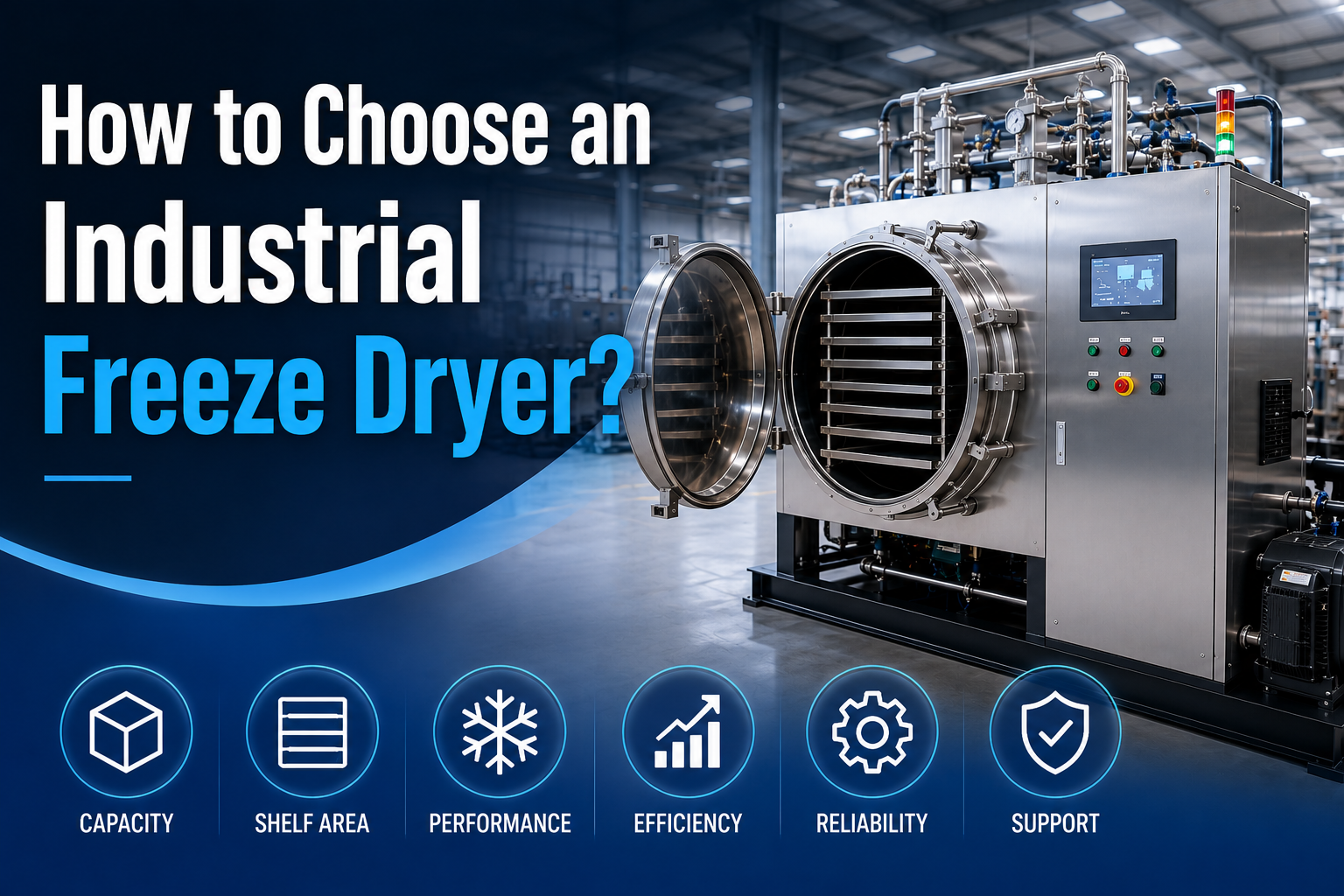
How to Choose an Industrial Freeze Dryer
When purchasing an industrial freeze dryer, drying time should not be considered separately from production capacity.
For example, if one batch requires 20 hours and the required daily production is high, the equipment must have sufficient chamber and shelf capacity to meet the production target.
Important factors to evaluate include:
Effective shelf area
Batch capacity
Condenser capacity
Freezing performance
Vacuum system
Shelf temperature range
Control system
Refrigeration system
Product characteristics
Expected production volume
Choosing equipment based only on chamber size or nominal capacity can result in an unsuitable production solution.
A professional freeze dryer manufacturer can evaluate the product, expected output, and process requirements together to determine a suitable configuration.
Frequently Asked Questions
How long does freeze drying take?
A complete freeze drying cycle can take several hours to more than 24 hours. The actual time depends on product type, moisture content, thickness, loading quantity, equipment configuration, and final moisture requirements.
Can freeze drying be completed in one day?
Yes. Many products can be processed within a day, but some products and industrial processes may require longer cycles. The actual time should be determined through product-specific testing.
What makes freeze drying take longer?
High moisture content, thick product layers, excessive loading, unsuitable freezing conditions, insufficient heat transfer, unstable vacuum, and high final moisture requirements can all increase drying time.
Does a larger freeze dryer dry products faster?
Not necessarily. A larger machine mainly provides greater batch capacity. Drying speed depends on the overall system design and product characteristics rather than equipment size alone.
How can freeze drying time be reduced?
Freeze drying time can potentially be optimized by controlling product thickness, loading density, freezing conditions, shelf temperature, vacuum conditions, and condenser performance. Process optimization should always maintain the required product quality.
Conclusion
Freeze drying time depends on both the product and the equipment. There is no universal cycle time that applies to every application.
Product type, moisture content, thickness, loading quantity, freezing conditions, shelf temperature, vacuum level, condenser capacity, and final moisture requirements all influence the drying process.
For companies planning commercial or industrial freeze drying production, the best approach is to evaluate these factors together rather than choosing a machine based only on nominal capacity.
If you are planning an industrial freeze drying project, provide your product type, expected batch capacity, and product loading information to a professional freeze dryer manufacturer. This information can be used to evaluate the appropriate equipment configuration and estimate the processing requirements for your application.
原文链接:https://www.xshiyu.com/hk/ldgzjzx/340.html
註:著作權歸贛州大昌冷氣設備工程股份有限公司所有。商業轉載請聯絡作者授權,非商業轉載請註明出處。
相關推薦

加微信
主要產品:真空預冷設備、檔案殺蟲消毒滅菌設備、真空冷凍乾燥機、解凍設備、文物檔案圖修復設備、低氧氣調殺蟲消毒機、真空除異味機、除塵消毒淨化設備、超高壓滅菌設備、低氧倉動物安樂暈設備
版權所有 © 2026 新世宇裝備 保留所有權利。  贛ICP備14002809號-1 XML
 得獎公眾號碼36070202000515