
What Factors Affect Freeze Drying Time?
What Factors Affect Freeze Drying Time?
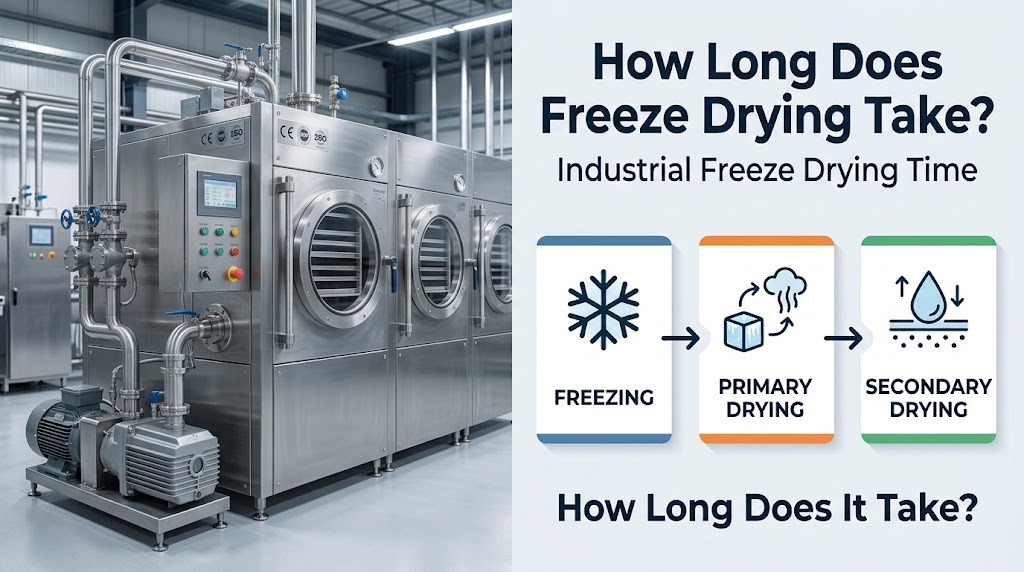
How long does freeze drying take? This is one of the most common questions asked when selecting a freeze dryer for food, pharmaceuticals, pet treats, and other temperature-sensitive products.
The answer is not a fixed number. Freeze drying time can range from several hours to more than 24 hours depending on the product, equipment, process parameters, and required final moisture content.
Understanding the factors that affect the freeze drying process can help manufacturers improve production efficiency, product quality, and energy consumption.
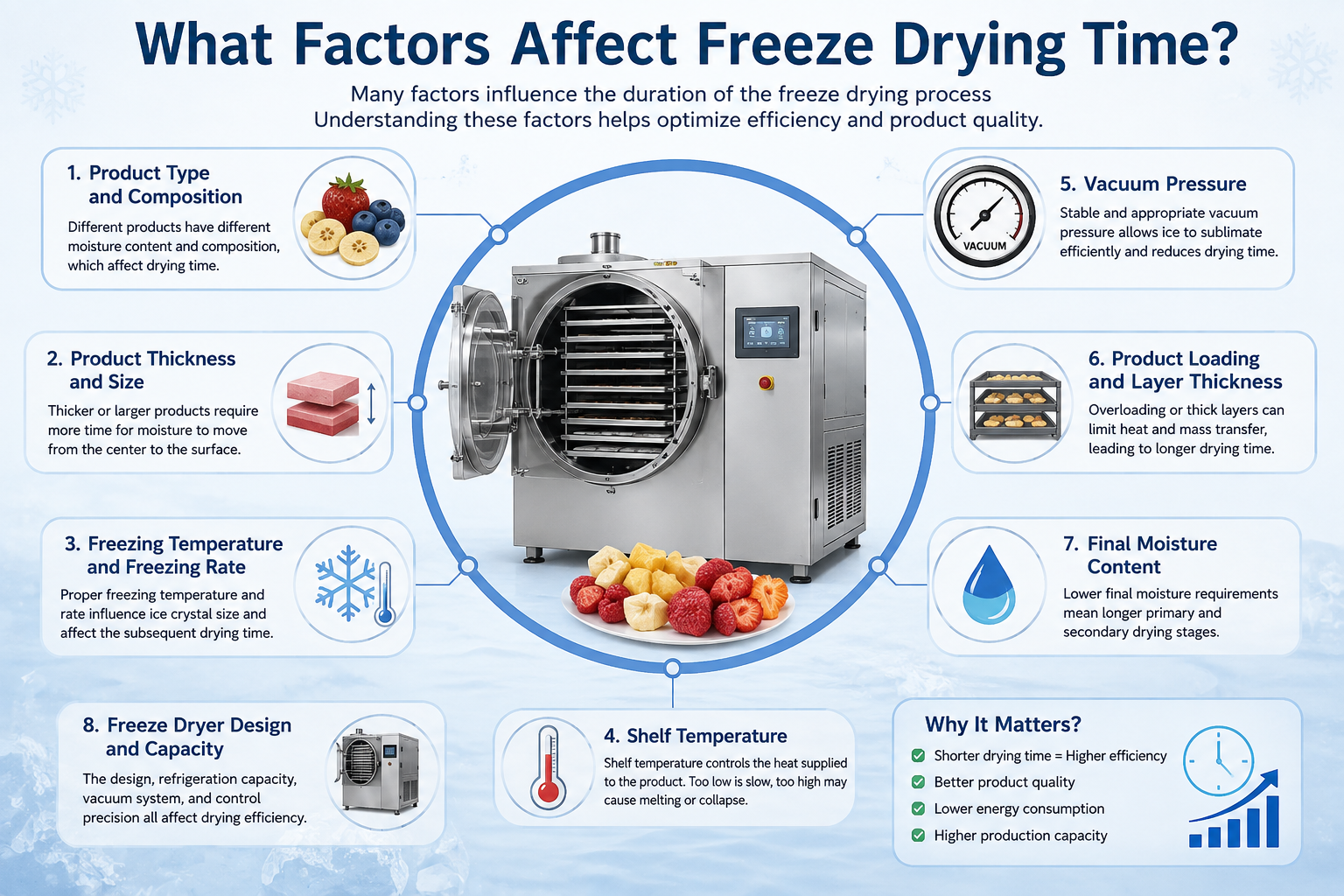
1. Product Type and Composition
The type of product is one of the most important factors affecting freeze drying time.
Products with high moisture content generally require more time to remove water. For example, fruits and vegetables contain a large amount of free water, while some pharmaceutical products may have different moisture characteristics.
The composition of the product also matters. Sugars, proteins, fats, and other solids can affect how easily water moves through the product during sublimation.
Therefore, two products with the same weight may require completely different processing times in an industrial freeze dryer.
2. Product Thickness and Size
Product thickness has a major impact on drying time.
Thin slices usually dry faster because the distance that water vapor needs to travel is shorter. Thick pieces or large products require more time because moisture must move from the center of the product toward the surface.
For this reason, controlling the thickness and loading arrangement is important when processing freeze dried food.
For example, evenly spreading fruit slices in a tray can provide better heat and mass transfer than placing large pieces on top of each other.
3. Freezing Temperature and Freezing Rate
Freezing is the first major stage of the freeze drying process.
Before sublimation begins, the product must be sufficiently frozen. The freezing temperature and freezing rate influence the size and structure of ice crystals inside the product.
A faster freezing rate generally produces smaller ice crystals, while slower freezing can produce larger crystals. These differences can affect the structure of the dried product and the movement of water vapor during drying.
An appropriate freezing process is therefore essential for achieving consistent drying results.
4. Shelf Temperature
Shelf temperature determines how much heat is transferred to the product during sublimation.
If the shelf temperature is too low, sublimation may proceed slowly and freeze drying time will increase.
If the shelf temperature is too high, the product temperature may exceed its critical temperature. This can cause product collapse, melting, or loss of quality.
The optimal freeze drying temperature depends on the characteristics of the product and its formulation. A well-designed freeze drying system should provide stable and precise shelf temperature control.
5. Vacuum Pressure
Vacuum pressure is another critical factor.
During vacuum freeze drying, the pressure inside the chamber is reduced so that ice can change directly from solid to vapor through sublimation.
If the vacuum level is unstable or unsuitable for the product, sublimation efficiency may decrease and drying time may become longer.
A reliable vacuum system is therefore an important part of professional freeze drying equipment, especially for continuous industrial production.
6. Product Loading and Layer Thickness
The amount of product loaded into each tray also affects drying time.
Overloading the trays or creating a thick product layer can restrict heat transfer and vapor movement. This can significantly increase the total drying time.
For industrial applications, manufacturers should determine the appropriate loading capacity based on product type, tray size, thickness, and desired moisture level.
The rated capacity of an industrial freeze dryer should therefore not be considered only in terms of kilograms. Actual production capacity also depends on the product and process.
7. Final Moisture Content
The required final moisture content directly affects freeze drying time.
If a product only needs partial moisture removal, the process may be relatively short. Products requiring very low residual moisture can require considerably longer primary and secondary drying stages.
For pharmaceuticals, nutraceuticals, and premium food products, controlling residual moisture is often essential for shelf life, stability, texture, and product quality.
8. Freeze Dryer Design and Capacity
The design of the freeze dryer itself can also influence processing time.
Important factors include:
·
Refrigeration capacity
·
·
Condenser temperature
·
·
Vacuum pump performance
·
·
Shelf temperature uniformity
·
·
Heat transfer efficiency
·
·
Chamber design
·
·
Automatic control system
·
A properly designed industrial freeze dryer can maintain stable temperature and vacuum conditions throughout the process, helping manufacturers achieve more consistent drying results.
How Can You Reduce Freeze Drying Time?
Reducing drying time does not simply mean increasing temperature. The process needs to be optimized as a whole.
Manufacturers can improve efficiency by:
1.
Controlling product thickness and loading density.
2.
3.
Optimizing the freezing rate and freezing temperature.
4.
5.
Selecting suitable shelf temperatures.
6.
7.
Maintaining stable vacuum pressure.
8.
9.
Avoiding excessive tray loading.
10.
11.
Optimizing primary and secondary drying parameters.
12.
13.
Using properly sized freeze drying equipment.
14.
Process testing is especially important when moving from laboratory production to commercial-scale production.
How Long Does Freeze Drying Usually Take?
There is no universal answer to how long freeze drying takes.
For many food products, a complete cycle may take approximately 12 to 30 hours, while some products may require longer depending on their moisture content, thickness, formulation, and target residual moisture.
Pharmaceutical products can require even more carefully controlled cycles.
The best way to determine the actual freeze drying time is to conduct product testing and optimize the process according to the specific product characteristics.
Conclusion
Freeze drying time is affected by many variables, including product composition, thickness, freezing conditions, shelf temperature, vacuum pressure, loading capacity, final moisture requirements, and freeze dryer design.
For manufacturers planning commercial production, choosing the right industrial freeze dryer is only one part of the process. Proper process development and parameter optimization are equally important for achieving stable quality and efficient production.
Understanding these factors can help manufacturers reduce unnecessary drying time, improve energy efficiency, and produce consistent high-quality freeze-dried products.
原文链接:https://www.xshiyu.com/japan/ldgzjzx/337.html
注: 著作権は贛州大昌空調設備工程有限公司に属します。商業的に転載する場合は、著者に連絡して許可を得てください。非営利転載の場合は出典を明記してください。
関連する推奨事項



WeChatを追加する
主な製品:真空予冷装置、アーカイブ殺虫消毒滅菌装置、真空凍結乾燥機、解凍装置、文化財アーカイブ地図復元装置、低酸素調整殺虫剤消毒機、真空脱臭機、除塵、消毒浄化装置、超高圧滅菌装置、低酸素倉庫動物快適・スタン装置
著作権 © 2026 Xinshiyu Equipment 全著作権所有。  ガン ICP No. 14002809-1 XML
 当選公開番号 36070202000515