
How industrial freeze-drying technology is transforming fruit and pet food production
How industrial freeze drying technology is transforming fruit and pet food processing
In the past few years Demand for high value dry agricultural products Especially tropical fruits like durian and mango. and high quality freeze dried pet food has increased rapidly throughout Southeast Asia. To meet world class quality standards Food manufacturers are thus shifting from traditional heat drying methods to industrial vacuum freeze drying technology. (Lyophilization) more and more
It is different from traditional air drying or spray drying. It relies on high heat that causes heat-sensitive nutrients, colors, and flavors to deteriorate. Freeze drying works through a state change at low temperature and low pressure called sublimation.
In this technical overview We will explain how modern freeze drying technology works. And why has it become the gold standard in food preservation for fruit and pet food?
Key Principles: Understanding Ice Sublimation
The heart of industrial freeze drying is the triad of water. When the atmospheric pressure drops below 611 Pa (0.006 atm) and the temperature remains below 0°C, water cannot remain liquid.
When gently heated under high vacuum conditions The solid ice crystals in the product directly transform into water vapor without passing through the liquid state.
This special process preserves the original physical structure of the product cell walls. Prevents shrinkage, collapse or hardening.

3 important steps in industrial freeze drying
A complete industrial freeze drying cycle consists of three carefully controlled steps:
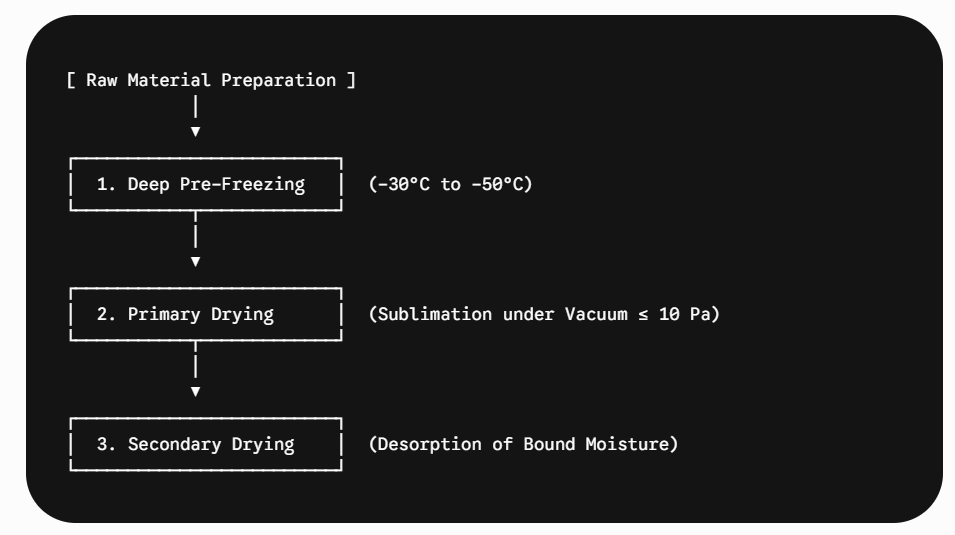
1. Steps before freezing
Raw ingredients, whether it be sliced durian Diced mango or fresh raw meat They are rapidly frozen at temperatures between -30°C and -50°C. Rapid freezing produces very small ice crystals. This helps prevent the rupture of delicate plant cells or animal muscle tissue.
2. Primary drying (sublimation)
The vacuum system reduces the pressure in the drying chamber to $\le\text{ Pa}$. The heating plate gradually Deliver energy through radiation/conduction to expel water vapor. In this initial step Approximately 90% to 95% of total moisture is removed.
3. Secondary drying (adsorption)
The moisture trapped within the molecular walls of the cell evaporates with a slight increase in temperature under very low pressure. This process reduces the final remaining moisture content to less than 2%–3%, allowing for up to 25 years of shelf life without the use of chemical preservatives.
Application focus: Why does freeze drying dominate the market?
Tropical fruits (durian, mango, pineapple, banana)
Preserving structure: Fruits high in sugar tend to stick and caramelize when heated. Sublimation preserves the airy and crisp texture that is popular in export markets.
Preservation of taste and aroma: Heat-sensitive volatile aromatic compounds are completely preserved. This keeps the aroma of tropical fruits intact.
Maintaining nutritional value: Vitamin C, antioxidants And less than 5% of the original pigment is degraded compared to more than 50% loss in heat drying.
2. Pet food and raw meat snacks (BARF food)
Complete Protein and Probiotics: Raw meat snacks retain their natural amino acid structure. Enzyme activity and heat-sensitive nutrients that are essential to your pet's digestive health.
2. Pet food and raw meat snacks (BARF food)
Complete Protein and Probiotics: Raw meat snacks retain their natural amino acid structure. Enzyme activity and heat-sensitive nutrients that are essential to your pet's digestive health. Rapid rehydration: The honeycomb-like porous structure created by sublimation of ice allows freeze-dried raw meat to rehydrate in warm water within seconds. Immediately returned to fresh meat.
Safety from Germs: Deep freezing and dry vacuum storage together naturally inhibit the proliferation of microorganisms and bacteria. without causing the protein to become denatured due to heat
Important technical factors for scaling up industrial production
For food processing plants planning to scale up commercial production Three engineering factors determine production efficiency:
Condenser Trap Capacity: Cold Trap (Condenser) The temperature must be kept below -50℃ to -80℃ to instantly freeze and store the steam. Stable vacuum level
Thermal Uniformity: Temperature fluctuations in the drying rack will lead to uneven moisture levels or melted products. (eutectic collapse)
Energy Consumption Management: Vacuum freeze dryers require an optimized heat transfer design (such as a special liquid heating system) to reduce the electricity demand per ton of finished product.
summarize
Understanding the thermodynamic mechanism of freeze drying technology Helps food processors improve product quality. Expand the scope of exports and meet the stringent demands of the high-end consumer market. Whether it is preserving tropical fruits or producing high quality pet food. Freeze drying remains the leading technology for food preservation today.
Original link: https://www.xshiyu.com/ldgzjzx/297.html
Note: The copyright belongs to Ganzhou Dachang Air Conditioning Equipment Engineering Co., Ltd. For commercial reprinting, please contact the author for authorization. For non-commercial reprinting, please indicate the source.
Related recommendations



Add WeChat
Main products: vacuum pre-cooling equipment, archive insecticidal disinfection and sterilization equipment, vacuum freeze dryer, thawing equipment, cultural relics archive map restoration equipment, low oxygen adjusted insecticide and disinfection machine, vacuum odor removal machine, dust removal, disinfection and purification equipment, ultra-high pressure sterilization equipment, hypoxic warehouse animal comfort and stun equipment
Copyright © 2026 Xinshiyu Equipment All rights reserved. Gan ICP No. 14002809-1 XML
 Winning Public No. 36070202000515